I used to spend every Sunday producing one YouTube video.
Script on Friday night. Voiceover on Saturday morning. Thumbnail on Sunday afternoon. By the time I hit publish, I had already missed the trending angle I was chasing. The topic was stale. The algorithm had moved on.
I knew there had to be a better way. Not just “use ChatGPT for scripts” — everyone says that. I mean a real system. Something that takes a topic and delivers a publish-ready package without me touching six different tools.
So I built one. This is the story of how I created a telegram bot for YouTube automation that changed my entire content workflow. Here is exactly what I built, how it works, and what the output looks like in practice.
Why I Stopped Doing It Manually
The math was simple and brutal. One video per week times six hours of production equals 24 hours per month. That is three full working days spent on production — not strategy, not growth, not research. Just production.
I was running a faceless channel called System Failure — documentary-style content about engineering disasters and hidden failures. No camera. No on-screen personality. Just research, storytelling, and visuals.
Which meant the entire process could theoretically be automated. Every single step.
The problem was that automating each step individually still left me as the glue between them. Script from ChatGPT, paste into ElevenLabs, download audio, open Canva for thumbnail, back to vidIQ for SEO, write description manually. Seven tools. Seven logins. Still two hours per video minimum.
I needed one system. One trigger. One output.
What I Built: A 7-Agent Telegram Bot
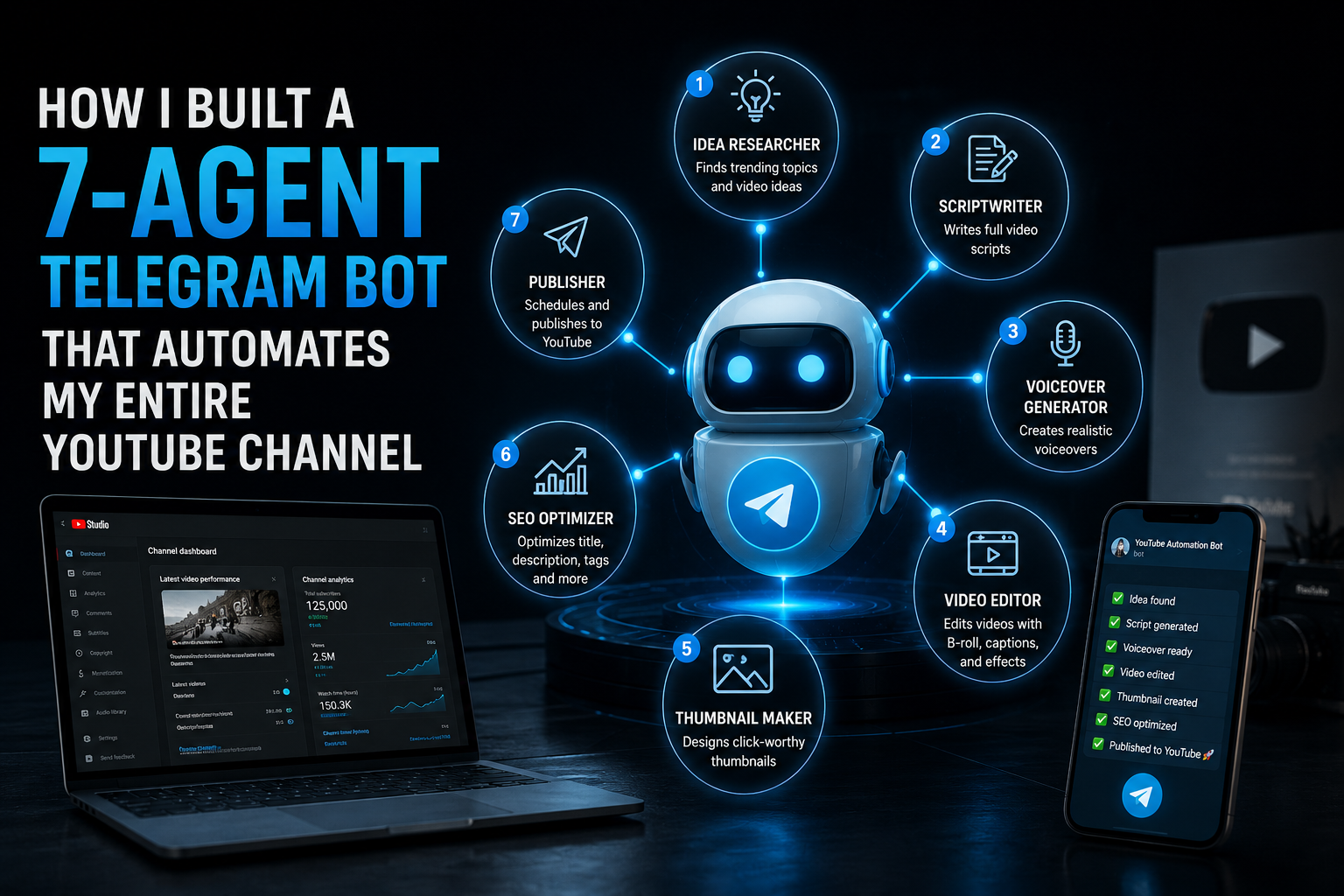
The solution lives inside Telegram. You send it a topic or keyword. It routes that input through seven specialized AI agents, each responsible for one specific part of the content pipeline.
Here is what each agent handles:
Agent 1 — Topic Researcher. Analyzes your keyword for search demand, competition level, and content gaps. Outputs a refined brief with the strongest angle — including what competitors are missing.
Agent 2 — Script Writer. Uses the brief to write a full retention-optimized video script. Hook in the first 30 seconds, structured value delivery, strong close.
Agent 3 — Voiceover Generator. Converts the script into a ready-to-use MP3 file. Drops directly into CapCut or any editor without additional processing.
Agent 4 — SEO Optimizer. Generates a title, full description with natural keyword placement, and a complete tag set — based on what is actually ranking for your topic right now.
Agent 5 — Thumbnail Strategist. Creates a detailed thumbnail brief: text overlay, color direction, visual composition. Actionable in five minutes with any AI image tool.
Agent 6 — Idea Generator. Outputs five related video ideas for your niche. Keeps your content calendar full without manual research sessions.
Agent 7 — Archive Packager. Collects every output and delivers a structured archive to your Telegram chat. Everything labeled, everything ready.
What the Output Actually Looks Like
This is the part most people do not believe until they see it.
Caption: Every archive contains 7 text files plus a voice.mp3 — total production time on my end is 30-45 minutes
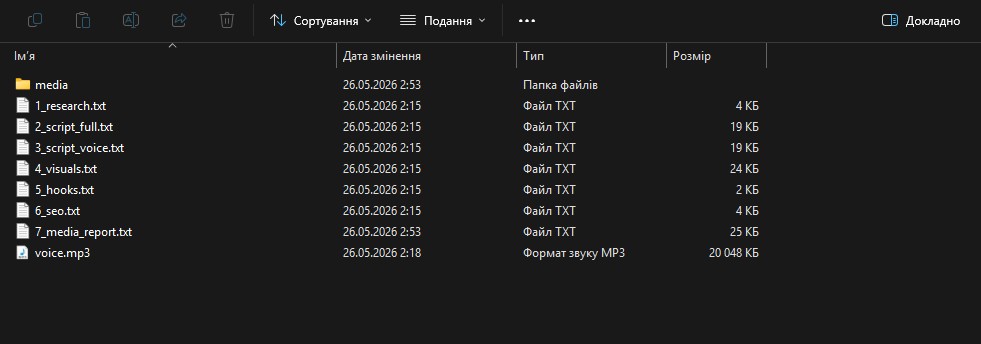
Every archive contains the same structure:
— 1_research.txt — competitive analysis and content angle (4 KB) — 2_script_full.txt — complete video script with notes (19 KB) — 3_script_voice.txt — voiceover-optimized version of the script (19 KB) — 4_visuals.txt — shot-by-shot visual direction (24 KB) — 5_hooks.txt — alternative hook options (2 KB) — 6_seo.txt — title, description, tags (4 KB) — 7_media_report.txt — full production report (25 KB) — voice.mp3 — ready-to-use AI voiceover (20 MB)
Caption: The research agent identifies content gaps competitors are missing — this is what makes the scripts stand out
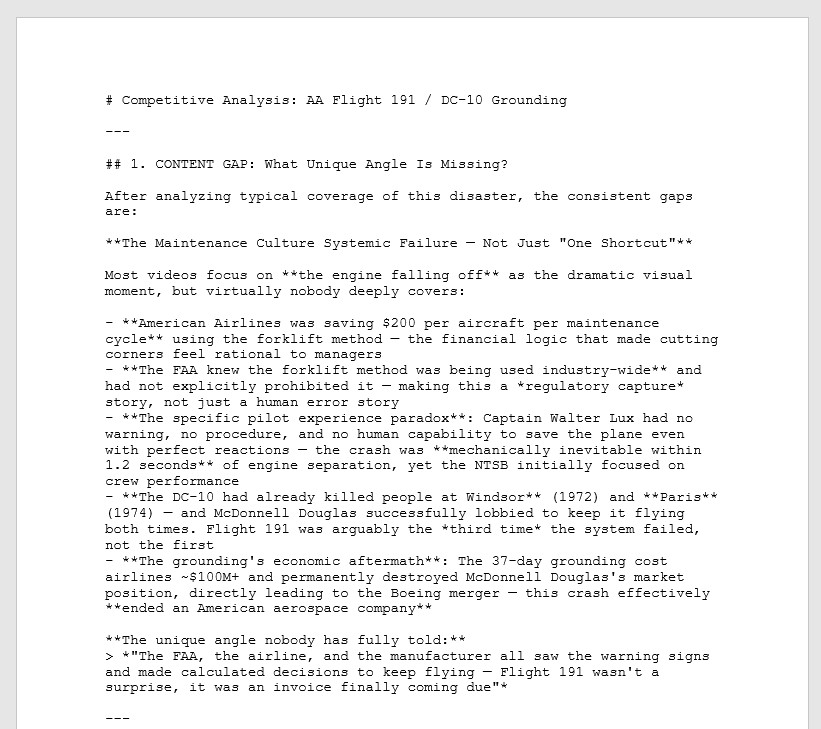
The research file alone saves two to three hours of manual work per video. It tells you exactly what angle to take and why — based on what existing videos are not covering.
The Real-World Result: System Failure Channel
I tested this system on my own channel. The first video — “The $500,000,000 Mistake Nobody Was Supposed to Admit” — was produced entirely using this bot workflow.
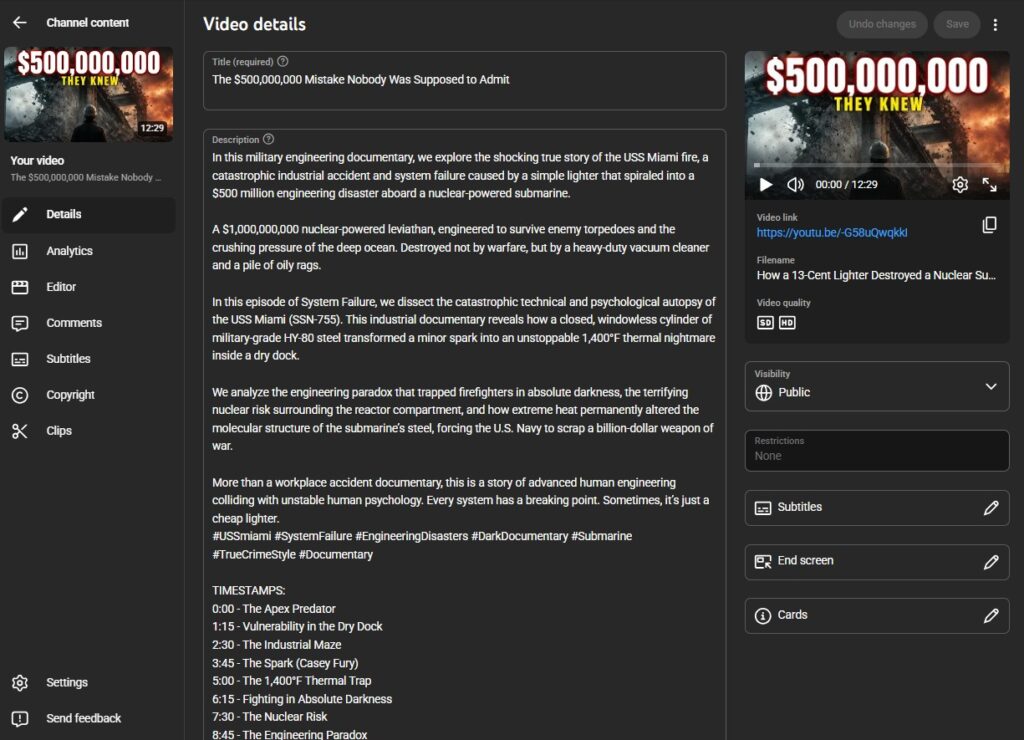
Caption: YouTube Studio showing the video details — title, description and timestamps all generated by the SEO agent
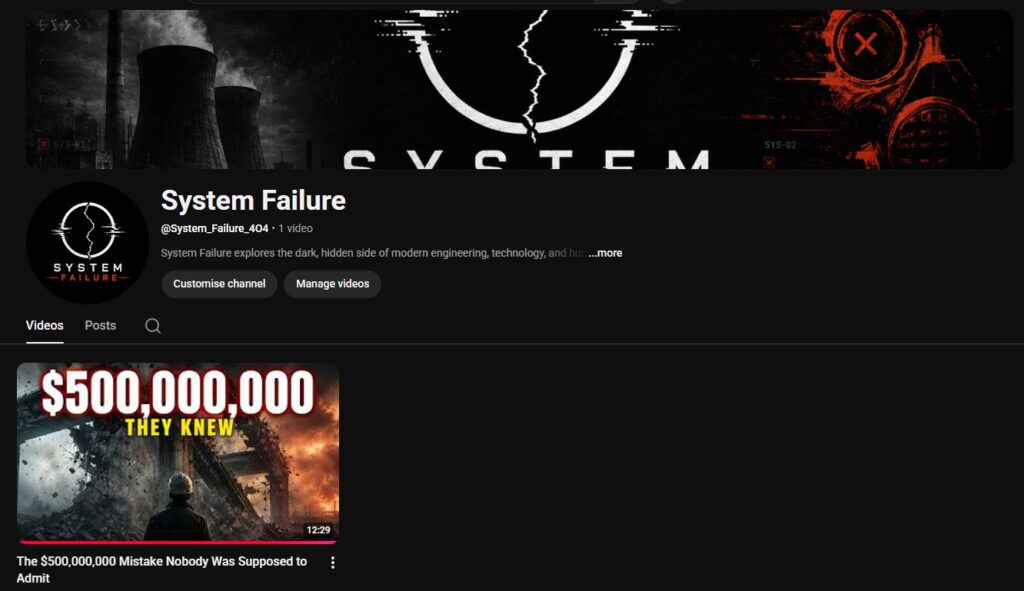
Caption: System Failure channel — built and published using the TubeAgents AI bot workflow
The SEO agent generated the full description, timestamps, and tags. The script agent wrote the 12-minute narrative. The voiceover agent delivered the MP3. Total time I spent in production: 38 minutes of editing in CapCut.
How This Compares to Manual Production
Without the bot: 6-8 hours per video, 5+ separate tools, constant context-switching, zero consistency when life gets busy.
With the bot: send a topic, receive the archive in 20-40 minutes, spend 30-45 minutes in CapCut, publish. Repeatable every day if you want.
The consistency is the real win. YouTube rewards channels that publish regularly. When production time drops from six hours to forty-five minutes, consistency stops being a goal and becomes the default.
Who This Is For
This system works best for faceless channel creators who understand that volume and consistency beat occasional perfection. Documentary channels, niche education, history, finance, true crime — any format where content matters more than personality.
It also works for creators managing multiple channels. Same bot, same workflow, multiple topics per day.
If you film yourself and build a personal brand — this is not your tool. But if you want to publish consistently without the production grind — this removes the bottleneck entirely.
How to Get Started
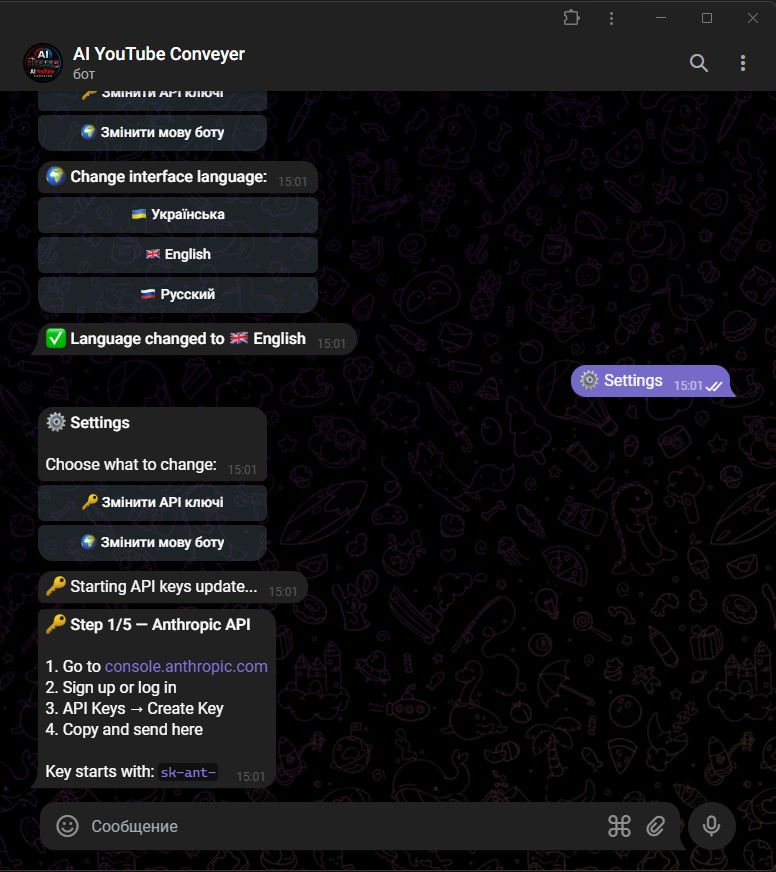
The bot runs on Telegram. You send a topic. The agents process it. You receive the archive. No complicated setup, no API dashboard to configure on your end.
Your first archive is free.
→ Start Free on Telegram — @AIYouTubeConveyerBot
Final Thought
I built this because I needed it. The gap between “I want to run a YouTube channel” and “I am publishing four videos per week” was a production problem — not a motivation problem.
The bot solved the production problem. The rest is up to you.