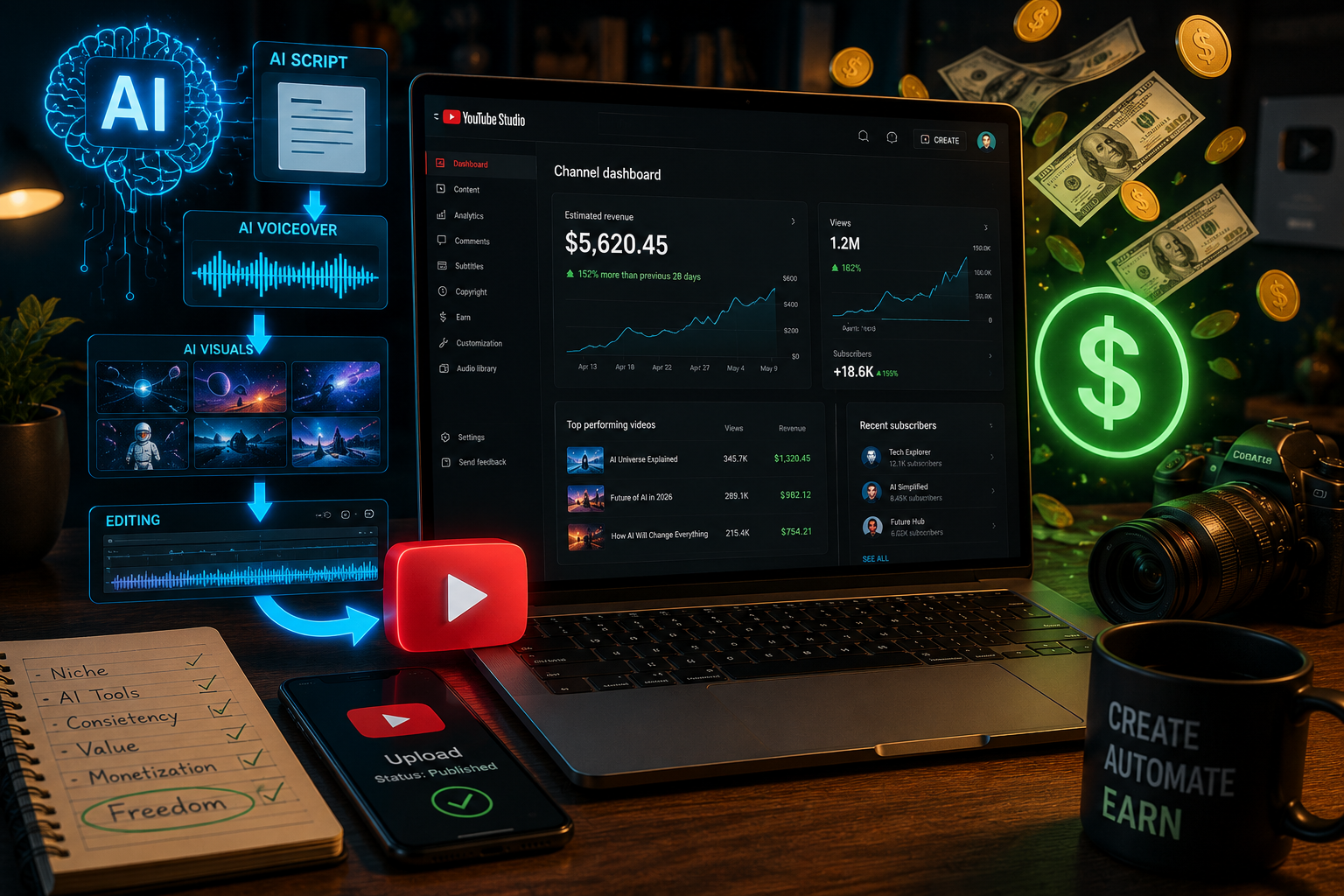
The question of AI generated YouTube videos monetization in 2026 has a clear answer: yes — but only if they meet YouTube’s originality and disclosure requirements. This isn’t a loophole. It’s the official policy, and there’s a real monetized AI-only channel to prove it.
I’ll walk you through exactly what YouTube requires, what gets channels demonetized, and the setup that works. If you’re considering starting a faceless YouTube channel with AI, the monetization question is the first thing you need to understand clearly.
YouTube’s Official AI Policy in 2026
YouTube updated its synthetic and AI content policy in March 2024 and has maintained that framework through 2026. The core rules haven’t changed — they’ve just become more strictly enforced. Here’s what matters:
- AI-generated content is allowed on the platform and is eligible for monetization through the YouTube Partner Program (YPP).
- Disclosure is required for “realistic” AI content — particularly videos that simulate real people, real events, or realistic news coverage. YouTube added an AI content label tool in YouTube Studio for this purpose.
- Mass-produced or repetitive AI content is not eligible for monetization. If your channel looks like a content farm — same template, no editorial voice, no distinct value — it will fail YPP review.
- AI-generated music has its own separate licensing rules outside the scope of this article.
The official source is YouTube Help under the “AI-generated content” section. Read it before you apply for monetization. The rules are specific and the review team checks them.
The “Transformative Content” Rule
This is the most important concept for AI channel creators. YouTube evaluates whether your content provides “value to viewers beyond simple regurgitation.” In practice, this means:
- A documentary that uses AI narration and AI images to tell a structured, researched story about a historical disaster — transformative.
- A video that takes a Wikipedia article, feeds it into a TTS tool, and puts stock footage over it — not transformative.
The distinction isn’t about whether AI was used. It’s about whether the final content has editorial intent, a distinct perspective, and educational or entertainment value. YouTube’s reviewers have seen every template out there. Channels that get approved for YPP with AI content typically have a clear niche, consistent quality, and genuine depth in their videos.
Real Proof: System Failure Is a Monetized AI-Only Channel
System Failure (@System_Failure_4O4) is a faceless YouTube channel in the engineering disasters niche. Every video — script, voiceover, images — was generated using @AIYouTubeConveyerBot. The channel is in the YouTube Partner Program and generates AdSense revenue.
The channel passed YPP review because it demonstrates exactly what YouTube requires: a defined niche, consistent format, genuine content depth, and videos long enough for mid-roll ads (15–22 minutes per episode). It’s not a hack or a loophole — it’s compliance with the actual rules.
This matters because most discussions about AI monetization are theoretical. System Failure is a working data point, not a prediction.
5 Things That Will Get Your AI Channel Demonetized
Understanding what fails is just as important as understanding what passes. These are the most common reasons AI channels get rejected from YPP or lose monetization after approval:
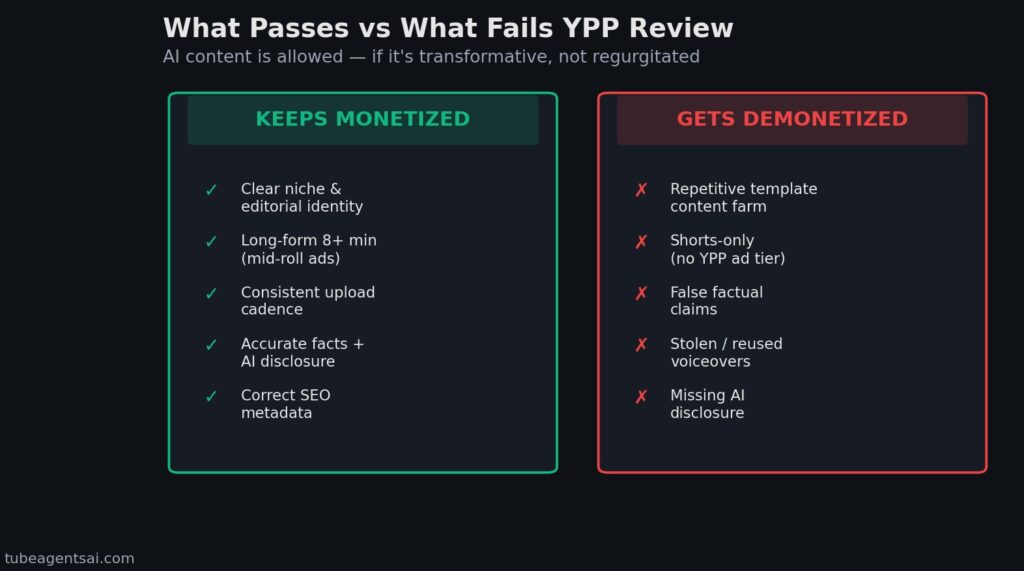
- Repetitive template content with no variation. If every video is structurally identical — same opening, same pacing, same voiceover style on unrelated topics — YouTube’s classifier flags it as mass-produced. Variation in topic, tone, and structure matters.
- AI-generated content that makes false factual claims. Documentary-style AI videos that state incorrect facts violate YouTube’s misinformation policy. Scripts need to be factually accurate. The @AIYouTubeConveyerBot stack uses research-grounded prompting — but you still need to fact-check.
- Missing AI disclosure when required. If your video realistically depicts people, places, or events in a way that could mislead viewers, and you haven’t disclosed it’s AI-generated, YouTube can remove monetization and may remove the content.
- Stolen or reused voiceovers. Using someone else’s audio — even modified — without licensing is a copyright strike waiting to happen. Use AI voices you have rights to, or a licensed TTS service.
- Short-form content only. Channels built entirely on Shorts cannot apply for the standard YPP ad revenue tier. You need long-form content with watch time hours accumulated. AI tools that only produce sub-3-minute content are monetization dead-ends.
5 Things That Keep Your AI Channel Monetized
- Clear niche with editorial identity. Your channel should be about something specific. “Engineering disasters” is a niche. “Interesting facts” is not. A defined identity signals to YouTube’s reviewers that there’s a creator perspective, not just an algorithm running content.
- AI disclosure in video descriptions. For any content that might be considered realistic simulation, add a standard disclosure line in your description: “This video was created with AI-generated voiceover and images.” Simple, required in some contexts, and it builds viewer trust.
- Long-form videos (8+ minutes). Mid-roll ads don’t activate until 8 minutes. Videos under that threshold earn nothing per impression beyond a pre-roll. The monetization math only works with long-form. At 15+ minutes, you get 2–4 mid-roll positions.
- Consistent upload cadence. YouTube’s algorithm rewards consistency. One video per week on a steady schedule performs better than bursts of 5 videos followed by silence. This is where the pay-per-video model of @AIYouTubeConveyerBot makes sense — you order exactly when you need content, at $10 per video, without a subscription forcing you to overproduce.
- Correct metadata and SEO. Proper titles, descriptions, and tags help YouTube classify your content correctly. Misclassified content can be flagged as misleading even when it isn’t. The 03_seo.txt file in each @AIYouTubeConveyerBot archive includes optimized metadata ready to paste.
Channel Setup: AI Disclosure Settings
Here’s the exact setup sequence for a new AI faceless channel targeting monetization:
- Go to YouTube Studio → Settings → Channel → Advanced Settings.
- Under “Audience,” confirm whether your content is made for kids (AI documentary content is typically “not for kids” — this matters for ad categories).
- When uploading each video, go to the Details tab → More options → Altered or synthetic content. Check the box if your video uses realistic AI depictions of real events or people. For clearly documentary AI content, this is a best practice even when not strictly required.
- In your video description, add a standard AI disclosure line at the end.
- Apply for YPP only after you have: 1,000 subscribers, 4,000 watch-time hours (or 10M Shorts views), and at least 12 months of channel history with no active strikes.
The full automation guide for faceless channels covers the channel setup in more detail, including playlist structure and the upload workflow that maximizes watch time accumulation speed.
How Long Until You Hit AdSense?
The honest timeline for a new channel starting from zero in 2026:
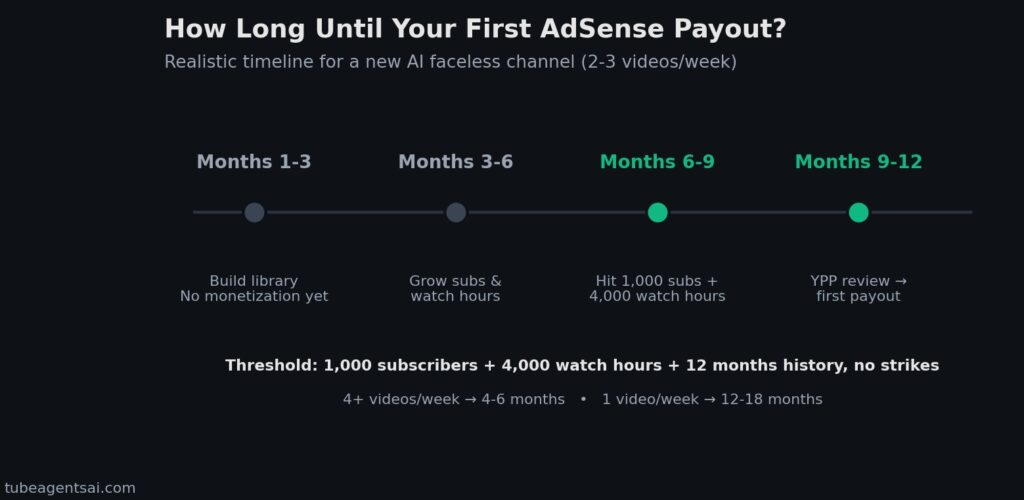
- Months 1–3: Building content library. No monetization eligibility yet. Focus on uploading consistently and accumulating watch time.
- Months 3–6: If uploading 2–4 videos per week, you’re accumulating subscribers and watch hours. Channels in high-CPM niches (engineering, finance, science) tend to grow faster because their content gets recommended to educated adult demographics.
- Months 6–9: Most AI faceless channels hit the 1,000/4,000 threshold in this range if they’re publishing consistently. Some hit it sooner in trending niches.
- Months 9–12: After YPP application review (typically 1–4 weeks), first AdSense payment. YouTube pays on a monthly basis for earnings above $100.
The 6–12 month window is realistic for channels doing 2–3 videos per week in a decent niche. Channels doing 1 video per week should expect 12–18 months. Channels doing 4+ per week can hit it in 4–6 months. For batch creation and scheduling strategy, see the batch video automation guide.
Which AI Tools Pass YPP Review?
This is the question that actually matters for implementation. The tools that tend to produce YPP-eligible content share a few characteristics:
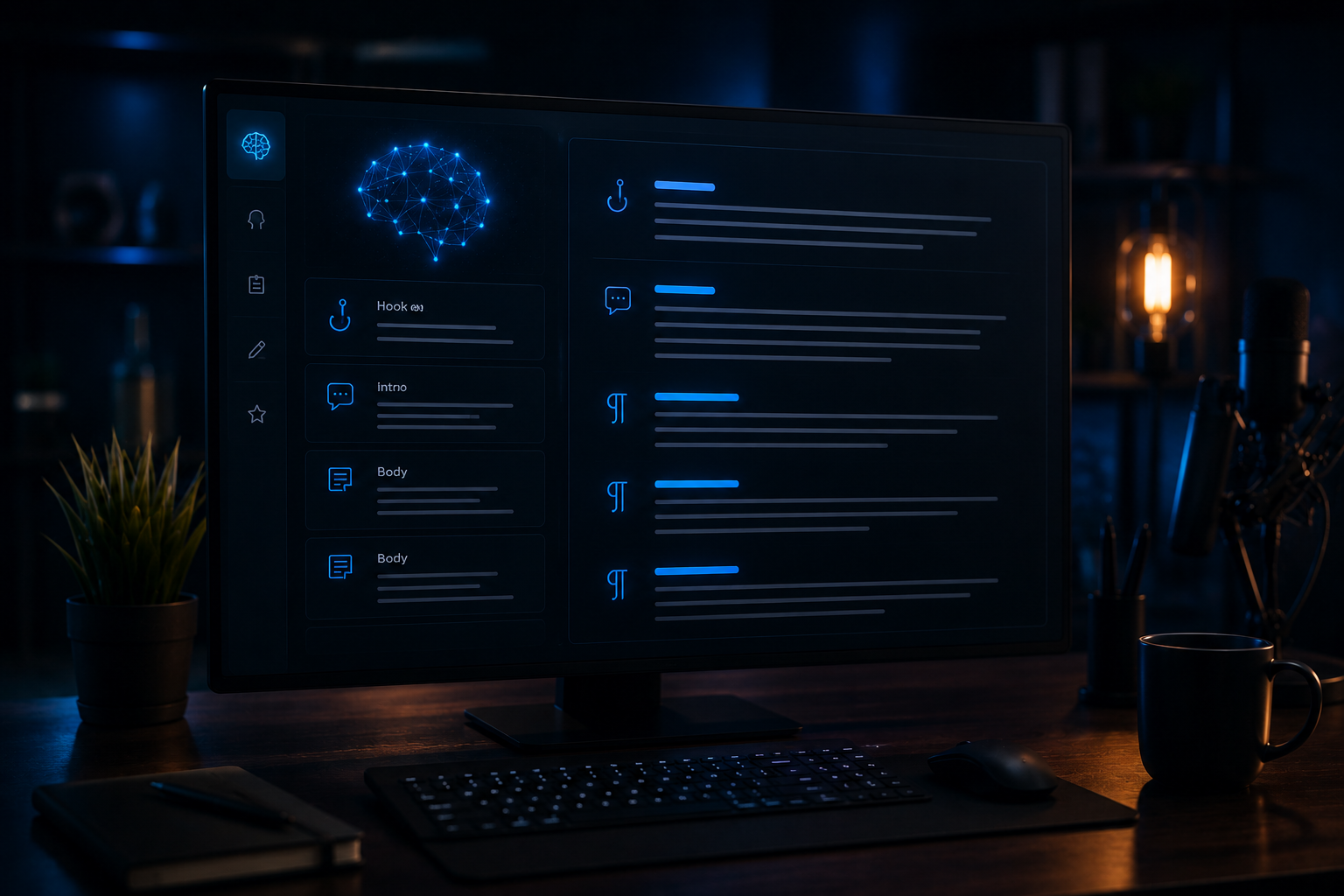
- Full-length scripts (not summaries) with actual narrative structure — not just bullet points read aloud.
- High-quality AI voiceover that doesn’t sound like a robotic TTS from 2018. YouTube viewers have high standards now. Bad audio is a retention killer and a soft demonetization signal.
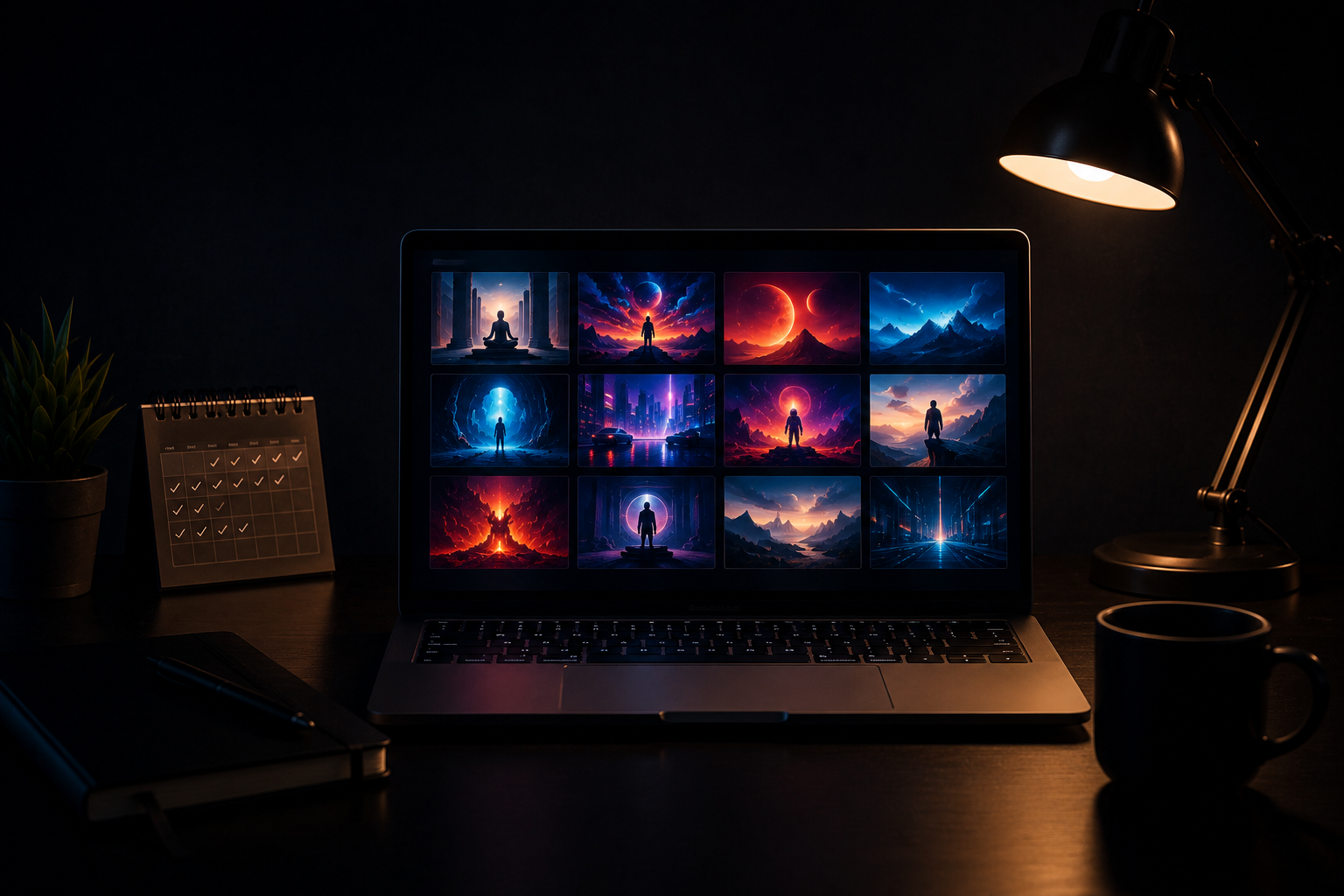
- Synchronized visuals that are topically relevant, not random stock imagery. YouTube’s classifier looks at whether the visual content matches the audio topic.
The @AIYouTubeConveyerBot workflow produces all three: a researched, long-form script (Claude Sonnet); a natural AI voice (Fish Audio S1); and 108 topically synchronized images (GPT-Image-1 with a storyboard layer). Each $10 archive includes the SEO file and editing instructions. It’s built specifically for the 15–25 minute documentary format that is most likely to pass YPP review and earn mid-roll ad revenue. Check the AdSense policies and YouTube for Creators to understand the full eligibility criteria before applying.
FAQ
Do I have to disclose that my YouTube video is AI-generated?
Only for content that “could be mistaken for real” — specifically realistic depictions of real people saying or doing things they didn’t, realistic news-style content, or content depicting real events that didn’t happen. For clearly documentary or educational AI content with AI narration over AI images, disclosure is strongly recommended but not always strictly required. When in doubt, disclose. It protects you and builds viewer trust.
Is there a minimum video length for YPP monetization?
There’s no hard minimum length to be monetized, but the economic reality is clear: mid-roll ads only appear in videos 8 minutes or longer. Pre-roll ads only pay a fraction of mid-roll rates. A 5-minute AI video will earn roughly 25–30% of what a 15-minute AI video earns per 1,000 views in the same niche. Long-form matters for revenue, not just eligibility.
Can I use an AI voiceover and still pass the YouTube Partner Program review?
Yes. AI voiceover is explicitly permitted under YouTube’s current policies. Many YPP-approved channels use TTS or AI voice clones. The quality bar is the issue, not the technology. High-quality AI voices (ElevenLabs, Fish Audio, Play.ht) pass review easily. Low-quality robotic TTS tends to correlate with poor retention, which hurts the algorithmic signals that reviewers also look at.
What is the 8-minute mid-roll rule exactly?
Videos 8 minutes or longer are eligible for mid-roll ad breaks — ads that appear during the video, not just before it. YouTube recommends placing mid-rolls every 2–3 minutes in longer content. A 15-minute video with 3 mid-roll positions can earn 3–5× more per view than an 8-minute video with one. This is why the 15–25 minute format that @AIYouTubeConveyerBot produces is economically optimal for AdSense revenue.
Do AI-generated thumbnails hurt monetization?
No — AI thumbnails are not a monetization issue as long as they don’t violate thumbnail policy (no misleading clickbait, no adult content, no showing real people in misleading contexts). In fact, consistent, high-quality AI-generated thumbnails can improve click-through rates significantly, which is a positive engagement signal. Just avoid any thumbnail that makes a claim the video doesn’t deliver on.
Bottom Line
AI-generated YouTube videos can be monetized in 2026. The rules are clear, the precedent exists, and the path is well-defined. What it requires is the same thing any monetized channel requires: real content, a real niche, consistent uploads, and compliance with platform policies.
If you want to skip the technical stack and start publishing immediately, @AIYouTubeConveyerBot delivers a complete, monetization-ready video archive for $10 — no subscription, no commitment. Order one video, edit it, publish it, and see how the format works before scaling.