YouTube Shorts crossed two billion logged-in users per month in 2025, and growth hasn’t slowed. If you’re building a YouTube channel in 2026 and you’re not using Shorts, you’re leaving the fastest organic reach on the platform untouched. The barrier? Most creators think Shorts require even more work than long-form videos — constant daily filming, tight editing, and an endless content calendar. The reality is the opposite. Faceless YouTube Shorts automation with AI has made it possible to produce and publish ten Shorts in a single day without filming a single second of footage. This guide shows you exactly how.
Why Faceless Shorts Work Better Than Regular Videos
There’s a common assumption that Shorts are just cut-down versions of regular videos — quick clips you export from longer content. That’s one approach, but it misses what makes Shorts genuinely powerful as a growth tool.
Shorts live in their own feed and are distributed independently from your main channel videos. A viewer who has never seen your channel can discover a Short, subscribe, and then find your long-form content. The algorithm pushes Shorts aggressively to new audiences, which means every Short is a discovery opportunity, not just content for existing subscribers.
For faceless channels specifically, Shorts remove every friction point that stops people from starting. No camera setup. No microphone. No worrying about lighting or background. A faceless Short is fundamentally a combination of three elements: a tight script (30–60 seconds), an AI voiceover, and stock visuals or screen recordings. All three can be generated or sourced without any original filming. This is why faceless Shorts, when automated, scale in a way that on-camera content simply cannot.
The format also rewards consistency over perfection. A Short published today and a Short published tomorrow both get their own algorithmic push. Volume compounds — ten Shorts a week means ten separate shots at going viral, reaching new subscribers, and building channel authority. Trying to achieve that with long-form content would require ten full video productions per week, which isn’t sustainable for a solo creator.
The Complete AI Workflow for Faceless Shorts (Script, Voiceover, Visuals)
A sustainable Shorts production pipeline has three layers, and AI handles all of them in 2026.
Layer 1: Script
A Short script is not a truncated long-form script. It’s a completely different format — one idea, one hook, one payoff. The structure that works consistently is: hook in the first three seconds (a bold statement, a surprising fact, or a direct question), two to four sentences of supporting content, and a CTA or punchline at the end. That’s the entire script. Total word count: roughly 80–120 words for a 30–45 second Short.
AI script generators handle this format well when given proper instructions. Specify that you want a Shorts script (not a long-form script), give the topic and target audience, and indicate the hook style you prefer. The output typically needs minimal editing. For more detail on AI script generation, see our full guide on how to generate YouTube scripts automatically with AI.
Layer 2: Voiceover
For Shorts specifically, voiceover pacing matters more than in long-form content. Viewers scroll fast — if the first three seconds of audio don’t land, they’re gone. AI voice tools like ElevenLabs and Play.ht let you control pacing and emphasis, which is worth spending an extra 30 seconds on for each Short. A slightly faster delivery with clear emphasis on the hook word or phrase performs better than a neutral, evenly-paced read. The complete breakdown of AI voiceover tools and techniques is covered in our AI voiceover for YouTube complete guide.
Layer 3: Visuals
Faceless Shorts visuals fall into three categories: stock video (Pexels, Pixabay, Storyblocks), AI-generated images or video clips, and screen recordings. The right choice depends on your niche. Finance and business Shorts work well with clean stock footage or data visualizations. Tech and AI Shorts often use screen recordings. Motivational or lifestyle Shorts use cinematic stock video. Most free-tier stock libraries have more than enough material for consistent Shorts production without spending anything on visuals.
The key visual principle for Shorts: match cuts to the script pacing. If your voiceover changes topic or makes a new point, the visual should change at that moment. Static visuals over an entire 45-second Short lose viewers fast. Aim for a new visual every 3–5 seconds at minimum.
How @AIYouTubeConveyerBot Automates Your Shorts Pipeline
The challenge with running a Shorts channel isn’t any single step — it’s the coordination between steps. You finish the script and have to switch to a voice tool. You finish the audio and have to find visuals. You finish the visuals and realize you forgot SEO metadata. Each context switch adds time and mental load, and over ten Shorts a day, that overhead adds up to hours.
@AIYouTubeConveyerBot eliminates this by handling the full pipeline inside a single Telegram conversation. Here’s what the workflow looks like in practice:
- You send a topic — for example, “3 signs you’re actually good with money” — along with any format preferences (Shorts, English, motivational tone).
- The bot generates a Shorts script — formatted correctly for the vertical format with a strong hook, tight body, and closing CTA.
- Voiceover instructions are included — the bot indicates emphasis points, pacing notes, and suggested delivery style alongside the script.
- SEO assets are produced in the same session — title, description, and tags optimized for Shorts discoverability, not just general YouTube search.
- The entire output arrives in one message — ready to take into your video editor without switching tabs or logging into additional tools.
If you want to understand the full multi-agent architecture behind the bot and why it produces better output than standalone AI tools, the breakdown is in our post on how we built a 7-agent Telegram bot for YouTube automation.
Step-by-Step: Create 10 Shorts in One Day with AI
Here’s the exact daily workflow for producing ten publish-ready Shorts using AI automation. This assumes you’re using @AIYouTubeConveyerBot for script and SEO, and a separate tool for voiceover and assembly.
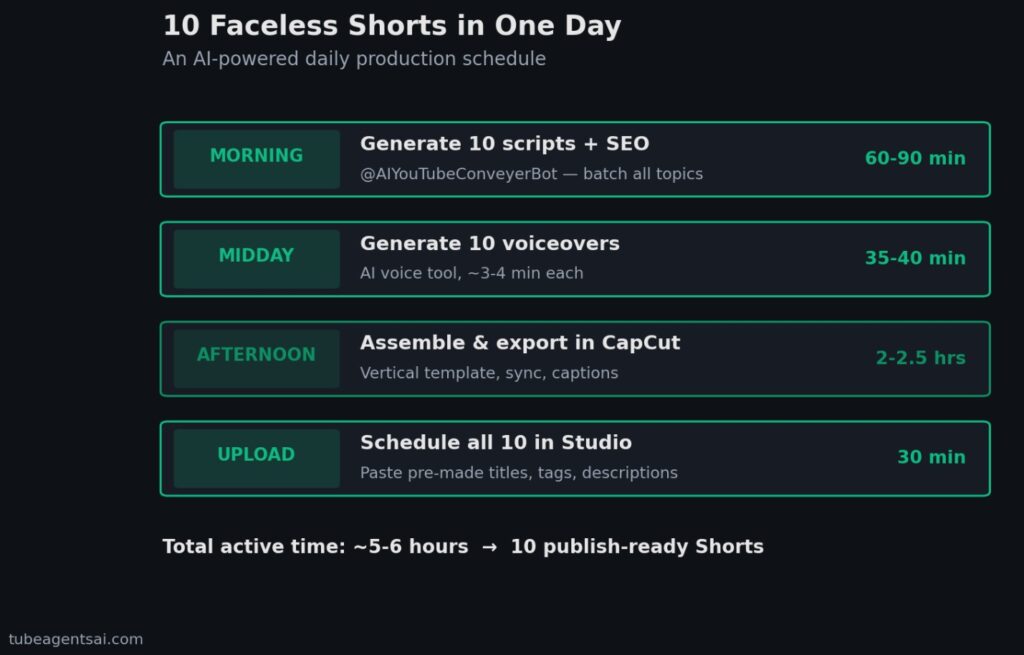
Morning Block (90 minutes): Generate All Scripts and SEO
Open @AIYouTubeConveyerBot and batch your topic inputs. Send all ten topics in sequence — you don’t need to wait for each to finish before sending the next. Within 20–30 minutes, you’ll have ten Short scripts with titles, descriptions, and tags ready. Review each script quickly, make any edits that feel necessary (usually minimal), and move them into a shared doc or folder organized by video number. This entire block should take 60–90 minutes including review time.
Midday Block (60 minutes): Generate All Voiceovers
With scripts ready, open your voiceover tool and process all ten in one sitting. Paste script one, generate, download, paste script two, generate, download — work through them sequentially. At roughly 3–4 minutes per Short, ten voiceovers take about 35–40 minutes. Name each audio file clearly matching your script numbering.
Afternoon Block (2–3 hours): Assemble and Export
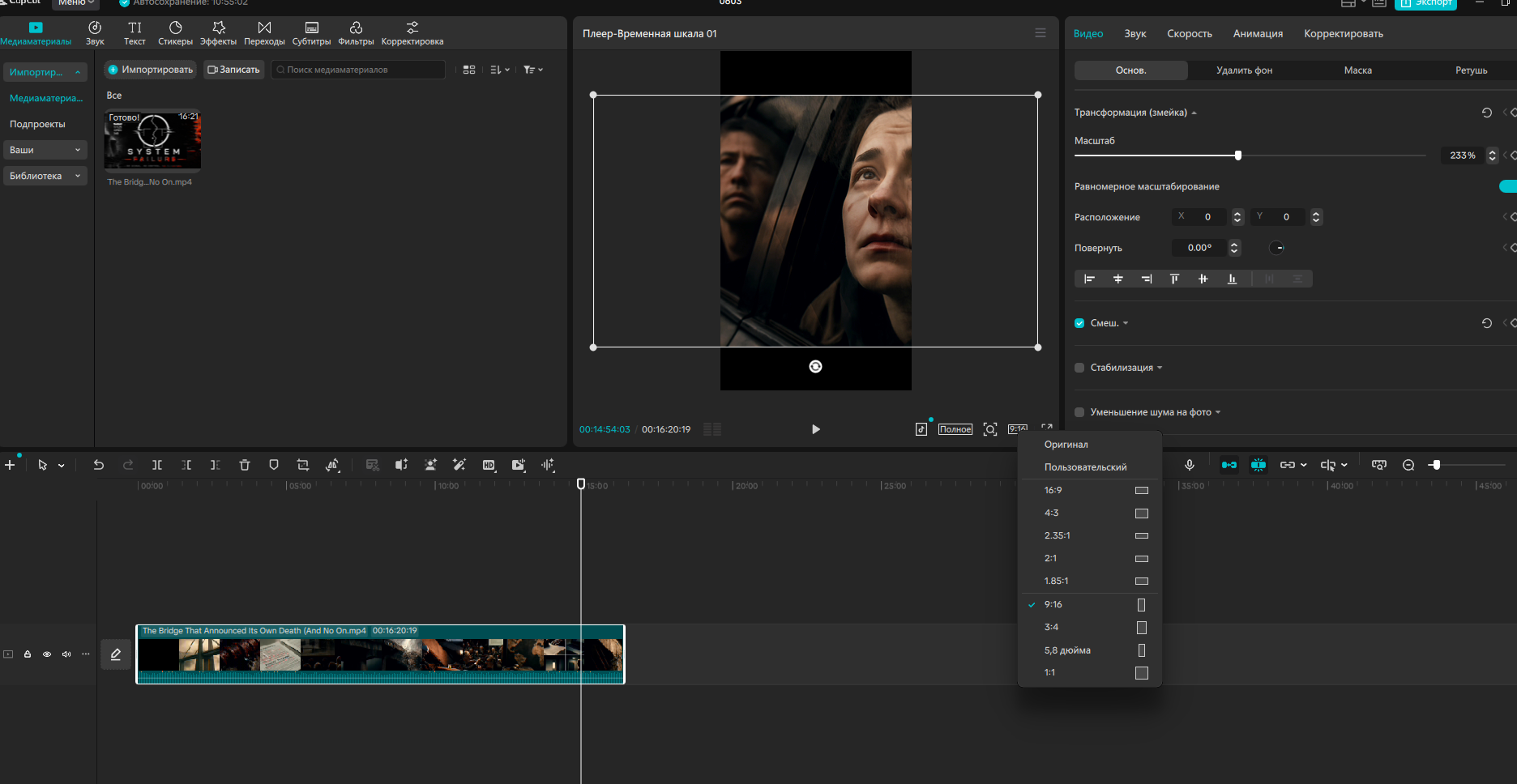
This is the most time-intensive step, but it becomes fast with practice and templates. Use a video editor (CapCut is popular for Shorts due to its free tier and vertical format presets) with a pre-built Shorts template: vertical canvas, text overlay style, transition style, and outro card already set up. For each Short, drop in the voiceover, pull stock visuals, sync cuts to audio, add captions (CapCut auto-captions are serviceable), and export. With a solid template, each Short takes 10–15 minutes to assemble — ten Shorts in 2–2.5 hours.
Upload Block (30 minutes): Schedule All Ten
Use YouTube Studio to upload and schedule all ten Shorts. Paste the pre-generated title, description, and tags from your bot output. Set your publishing schedule — two Shorts per day over five days, or one per day for ten days, depending on your channel strategy. Total upload and scheduling time: about 3 minutes per Short, 30 minutes for ten.
Total active time for ten Shorts: roughly 5–6 hours, most of which is the assembly block. With more practice and better templates, that drops to 4 hours or less.
Best Niches for Faceless Shorts in 2026
Not every niche performs equally well in the Shorts format. These are the categories that consistently see strong reach and subscriber conversion from faceless Shorts specifically.
Finance and money tips perform exceptionally well — short, punchy financial facts, budgeting hacks, and “did you know” style money content drives high shares and saves. Viewers bookmark financial content to revisit, which signals strong engagement to the algorithm.
AI and technology is one of the fastest-growing Shorts categories. Short explainers about new AI tools, “this AI can do X” formats, and quick tutorials drive high click-throughs from tech-curious audiences. This niche also benefits from the novelty cycle — there’s always a new tool to cover. For a closer look at how AI tools power full channel automation in this niche, see our breakdown of the best AI bots for faceless YouTube channels.
Motivational and mindset content remains one of the most consistently high-reach categories on Shorts. Simple quote-style videos, discipline advice, and “hard truths” formats accumulate views reliably because they’re broadly shareable across demographics.
History and facts work especially well for faceless channels because the format — narration over archival images or stock footage — is inherently anonymous and scalable. “Bizarre historical facts” and “things that happened 100 years ago today” formats have proven repeatability.
Productivity and life optimization Shorts — app recommendations, workflow tips, morning routine hacks — attract a high-value audience that tends to subscribe for more content rather than just watching one video and leaving.
Common Mistakes That Kill Shorts Performance
Producing high volume without avoiding these patterns wastes effort on content that won’t perform regardless of quantity.
Weak hooks. The first two to three seconds determine whether a viewer scrolls past or keeps watching. “In this video I’m going to tell you about…” is not a hook. “90% of people get this completely wrong” is a hook. Lead with the most interesting thing in your Short, not a preamble. If your AI-generated script doesn’t lead with something immediately compelling, rewrite the first line before anything else.
Posting irregularly. The Shorts algorithm rewards consistency more than long-form YouTube does. Posting ten Shorts in one day and then nothing for two weeks produces much worse results than posting one or two Shorts daily over the same period. Use the scheduling feature in YouTube Studio to spread your content evenly regardless of when you batch-produce it.
Ignoring captions. A significant percentage of Shorts are watched with the sound off, especially on mobile in public spaces. Shorts without captions lose these viewers entirely. Auto-caption tools in CapCut and YouTube Studio handle this in seconds — there’s no reason to skip it.
Not studying retention graphs. YouTube Studio shows average view duration for each Short. If viewers consistently drop off at the same point — say, 40% into the video — that tells you something specific is wrong at that moment. Review the segment, identify what’s causing the drop (slow pacing, weak transition, dull visual), and adjust your template for future Shorts.
Copying formats without understanding why they work. Trending Short formats work for specific reasons — pacing, information density, hook structure. Copying the surface appearance without understanding the underlying mechanic produces content that looks like a trend but doesn’t perform. Spend time understanding why a format works before replicating it at scale.
Conclusion: Faceless YouTube Shorts Automation Is the Fastest Path to Channel Growth in 2026
The case for faceless YouTube Shorts automation in 2026 comes down to simple math: more content published consistently, without a camera, without a recording setup, and without burning yourself out. AI handles the script, AI handles the voiceover, and a solid template handles the assembly. The only thing left is strategy — choosing the right niche, studying what works, and iterating.
The creators who will build the fastest-growing faceless channels this year are not the ones with the best cameras or the most charisma. They’re the ones who build the most efficient production pipelines and publish consistently while everyone else is still thinking about where to start.
If you’re ready to build that pipeline, start with the tool that handles the heaviest part of it automatically.
👉 Try @AIYouTubeConveyerBot free on Telegram — get your first batch of Shorts scripts, voiceover notes, and SEO assets in under five minutes.